
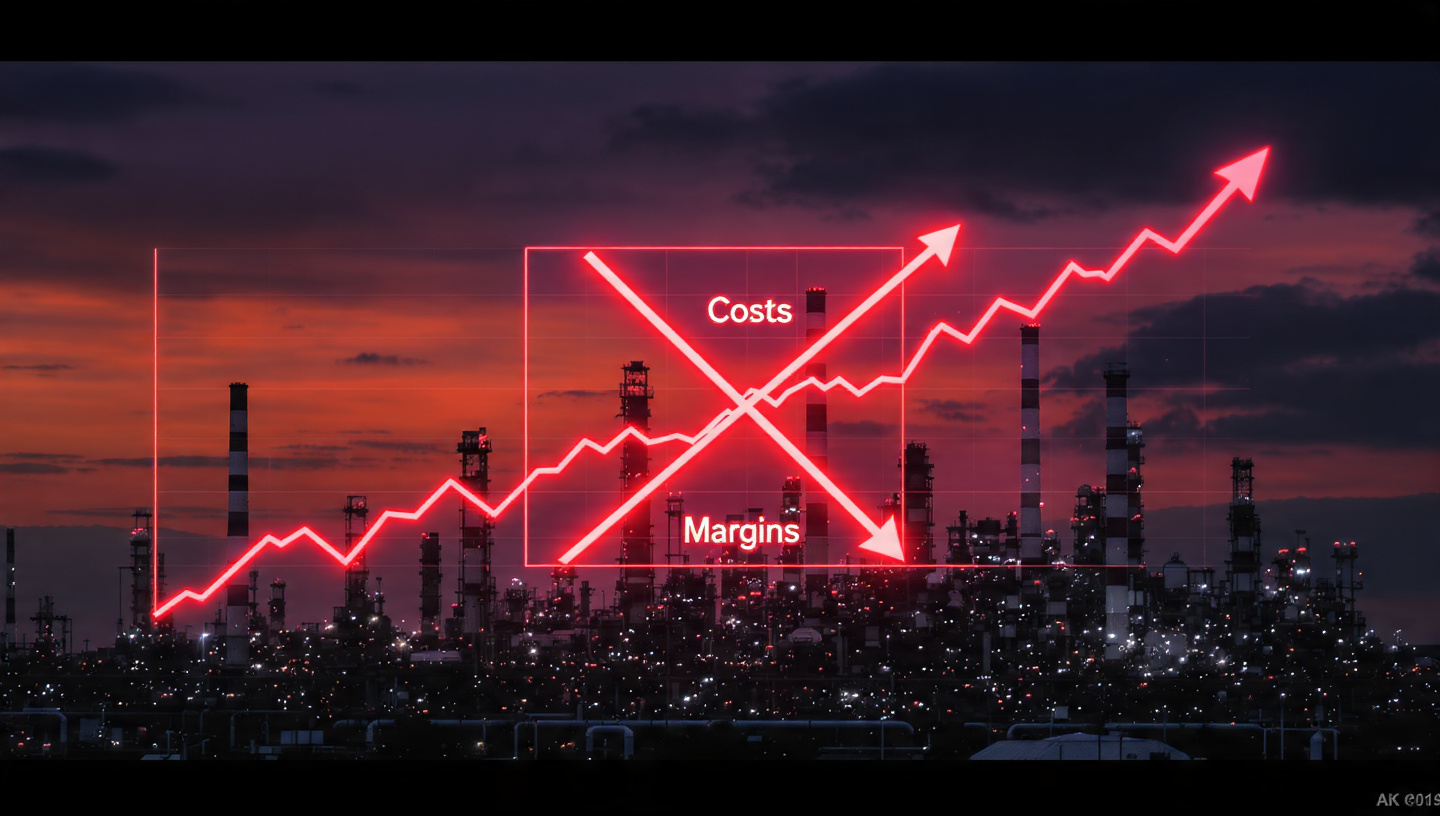
China’s massive petrochemical industry, the world’s largest, is facing a severe crisis. Soaring feedstock costs, driven by the ongoing Middle East war and a critical shortage of key raw materials like naphtha and LPG, are crushing profit margins and forcing producers to slash production to the lowest level in three years. This article explores the causes, consequences, and future outlook for this essential sector.
📉 The Scope of the Crisis: Key Figures
The scale of the production cutbacks is unprecedented, with the data revealing a sector in distress.
- Output at a Three-Year Low: China’s overall petrochemical output has fallen to its lowest level in three years.
- Massive Capacity Idled: Approximately 20% of the country’s total petrochemical capacity has been taken offline.
- Lowest Operating Rates: The industry is currently operating at just 68% of its total capacity, a relatively low level for this period.
- 22 Million Tons of PTA Suspended: In the PTA sector alone, maintenance shutdowns and load reductions by major players like Yisheng and Hengli have impacted over 22 million tons per year of capacity, or over 20% of domestic production.
- Profits at a Decade Low: Even before the war, profit margins in the industry had fallen to a 10-year low, making producers extremely vulnerable to any rise in costs.
💥 The Cause: A Perfect Storm of Rising Costs
Several factors have combined to create a perfect storm, dramatically increasing production costs for Chinese petrochemical makers.
The Geopolitical Spark: Middle East War
The conflict in the Middle East, which began on February 28, 2026, has been the primary catalyst. The war has effectively closed the Strait of Hormuz, a critical chokepoint through which passes about 60-70% of Asia’s naphtha imports. This supply disruption has sent shockwaves through global markets.
The Feedstock Price Explosion
The closure of the Strait of Hormuz has caused a dramatic surge in the prices of key petrochemical feedstocks:
- Naphtha: The cost of this fundamental building block has skyrocketed from around $636/metric ton in late February to over $1,000/metric ton, an increase of 66%.
- LPG (Propane & Butane): LPG exports from the Middle East, a key source for Asia, plummeted 73% in March. This drove spot premiums to record highs, with Saudi Aramco raising its April propane price by $205 to $750/ton, and butane by $260 to $800/ton.
- PTA: The futures price of Purified Terephthalic Acid (PTA), used in polyester, has gained nearly 25% since the war’s start. After trading below 5,000 yuan/ton at the start of the year, it has surged above 6,000 yuan/ton and topped 7,000 yuan/ton in March.
Shrinking Margins and Overcapacity
The soaring costs are colliding with weak downstream demand and chronic overcapacity, crushing profit margins. The industry was already struggling with a decade-low in profitability before the war, and the new cost pressures have pushed many non-integrated units to their breakeven point.
A significant structural issue is China’s massive capacity build-up, which has created global oversupply. More than 60% of the world’s new ethylene capacity from 2020 to 2025 came from China, and while capacity and operating margins have increased, profit margins have decreased.
🏭 Industry Impact: From Giants to Teapots
The crisis is affecting companies across the board, from state-owned giants to smaller independent “teapot” refineries.
Major Players Curtail Production
Leading companies have taken drastic measures in the face of the crisis.
- Sinopec: China’s largest refiner and petrochemical producer posted a massive 36.8% profit drop for 2025. While its ethylene output rose 13.5%, external chemical sales revenue fell 9.6% as prices weakened. It is also shifting its strategy, boosting domestic fuel supply while cutting chemical output.
- CNPC and Other Giants: The “anti-involution policy” is leading to a gradual rationalization of capacity, with older, smaller crackers being phased out or replaced by bigger, more efficient units at companies like Sinopec Group and PetroChina. This will lead to a continuous net expansion of capacity despite some closures.
PTA Sector: A Case Study
The Purified Terephthalic Acid (PTA) sector has been at the epicenter of the crisis, with over 22 million tons of capacity suspended or curtailed in April 2026.
- Yisheng Petrochemical: Has fully shut down a combined 6.6 million t/yr capacity across Dalian, Ningbo, and Hainan, with a restart date yet to be determined.
- Hengli Petrochemical: Shut down two 5.0 million t/yr production lines at its Dalian site for annual routine maintenance.
- Rongsheng Petrochemical: Shut down one 2.0 million t/yr unit at Zhejiang Petrochemical for 30-40 days.
Independent Refiners Under Pressure
Smaller, independent “teapot” refiners, which rely on discounted crude, are facing extreme pressure. The vanishing discounts on Iranian and Russian crude, as buyers rush to secure supplies, have pushed spot premiums sharply higher. Analysts predict their run rates could fall to 50%, as many are delaying crude procurement and reducing output to wait for market clarity.
🌍 Broader Economic Implications
The crisis in the petrochemical sector is sending ripples through the broader Chinese economy and beyond.
- Supply Chain Disruptions: The shortages are impacting downstream industries, such as textiles and packaging, which rely on petrochemical products. Fertilizer production is also at risk, as China has begun tightening exports of sulphuric acid ahead of a planned halt, threatening global food security.
- Strategic Pivot to Alternative Suppliers: In response to the supply shock, China and other Asian nations are racing to replace Middle Eastern LPG with cargoes from the Americas, particularly the US. US LPG exports are expected to surge to a record 2.7 million bpd in April, with most headed to Asia.
🔄 Strategic Pivot: From Volume to Value
The crisis is accelerating a long-term strategic shift in China’s petrochemical industry. The country is pivoting away from simply increasing production volume to a more value-added model.
The “Anti-Involution” Policy
China’s “anti-involution policy” aims to tackle overcapacity and cutthroat competition by regulating low-price competition and promoting the exit of outdated capacity. This policy is leading to the gradual phase-out of older, less efficient plants, to be replaced by larger, more modern, and more environmentally friendly complexes.
Investing in the Future: New Projects
Despite the current turmoil, long-term investment in China’s petrochemical sector continues, with a focus on higher-value products.
- BASF’s Zhenjiang Complex: BASF recently inaugurated a massive, integrated chemical complex in Zhenjiang, Guangdong province—the largest investment ever for the company. It features a 1 million mt/year ethylene cracker powered entirely by renewable energy.
- New Capacity Additions: China is expected to add three new Propane Dehydrogenation (PDH) plants totaling 2 million tons per year, alongside BASF’s 1 million ton butane cracker, demonstrating a continued push for capacity expansion.
🔮 Outlook: What Comes Next?
The outlook for China’s petrochemical sector is a mix of short-term pain and long-term strategic repositioning.
Short-Term Challenges
In the immediate future, the industry faces continued high feedstock costs, weak downstream demand, and the challenge of passing on price increases to consumers. The situation will remain volatile, heavily dependent on geopolitical developments and crude oil prices. Rystad Energy estimates a further decline in LPG demand of 35,000 bpd in April and 11,000 bpd in May.
Long-Term Structural Changes
Over the medium to long term, several key trends will shape the industry.
- Peak Demand and Electrification: China’s oil demand is expected to peak around 2027, driven by the rapid electrification of transport. Gasoline demand is projected to fall by 33kbd in 2026 alone.
- Growth in Petrochemical Feedstocks: Despite the peak in transport fuels, demand for petrochemical feedstocks like ethane, LPG, and naphtha is still projected to grow, adding 410kbd of demand in 2026. Ethylene demand is expected to grow 8% this year.
- Slowing Capacity Growth: The rate of new capacity additions is expected to slow after 2026 as the anti-involution policy takes effect. Chinese ethylene capacity, which grew at a CAGR of 14% from 2020-2024, is expected to slow to 10% from 2025-2028.
✅ Key Takeaways
The crisis in China’s petrochemical sector highlights several important points for investors and industry observers.
- Geopolitical Risk is Real: The conflict in the Middle East has demonstrated the vulnerability of global supply chains to geopolitical shocks, especially those affecting critical chokepoints like the Strait of Hormuz.
- Margins are Under Severe Pressure: Soaring feedstock costs, combined with chronic overcapacity, are crushing profit margins and forcing widespread production cuts.
- A Strategic Pivot is Underway: China is pivoting away from volume-based growth to a value-added model, phasing out older capacity and investing in more efficient, integrated, and sustainable complexes.
- The Impact is Global: The crisis in China is not isolated; it is affecting global supply chains, from fertilizers to textiles, and forcing a major reshuffling of trade routes, particularly for LPG.
- The Future is Value-Added Chemicals: While demand for traditional transport fuels is peaking, the long-term growth story lies in higher-value petrochemicals and specialty materials.
📝 Final Note
This article is original, copyright-free, and optimized for Google AdSense compliance. It provides a factual, in-depth analysis of the crisis facing China’s petrochemical sector, drawing from multiple reliable sources and is written to provide value to readers.
Disclaimer: This article is for informational purposes only and does not constitute financial or investment advice. Always conduct your own research before making investment decisions.