
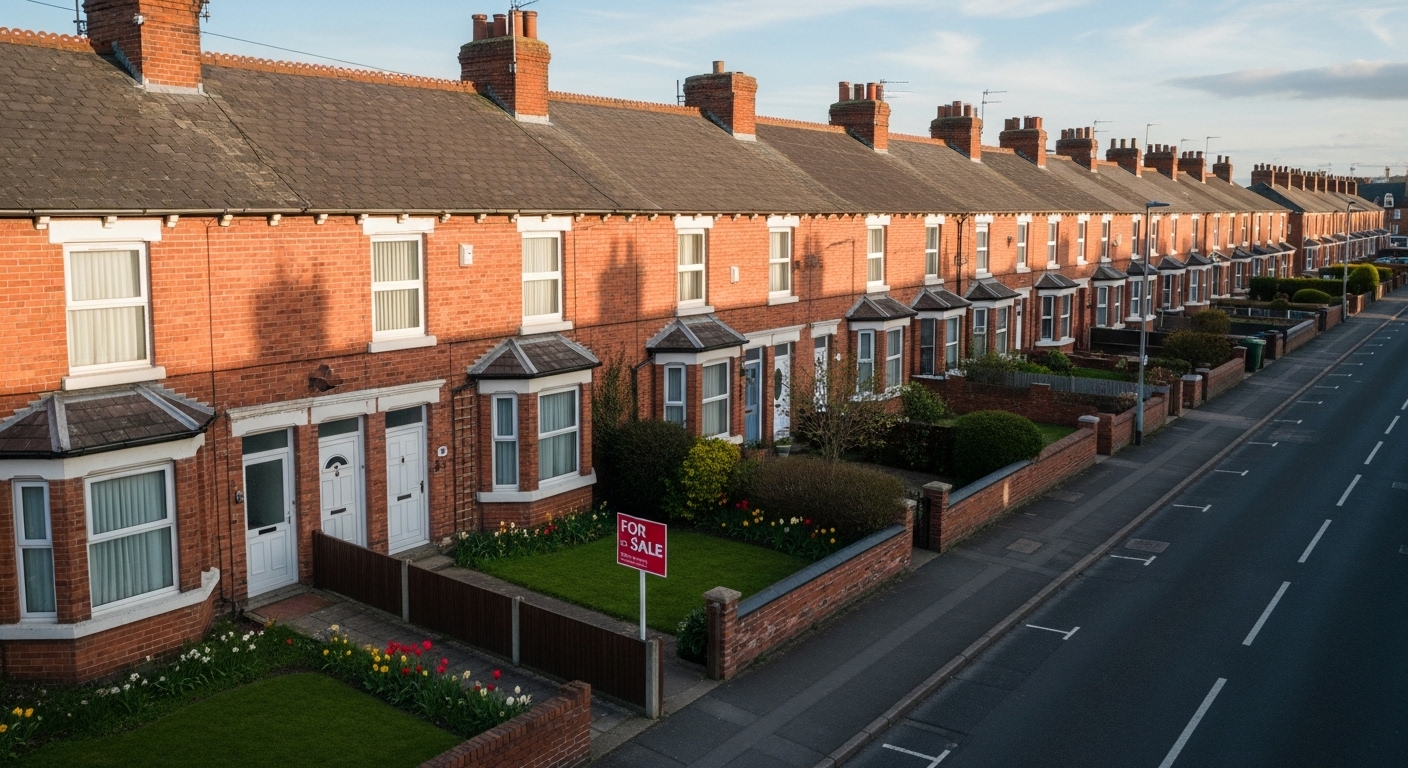
The UK property market in 2026 is sending mixed signals. Prices are still rising in parts of Scotland and Northern Ireland. In London and the South East, they are falling. Mortgage rates have climbed sharply due to geopolitical tension in the Middle East. The Renters’ Rights Act is weeks away from transforming the private rental sector. And yet, the number of agreed sales is holding up remarkably well — only 3% behind last year.
So what is really happening? Whether you are buying, selling, renting, or investing, this detailed breakdown of the UK property market in 2026 covers everything you need to know right now.
House Prices: The National Picture
The average asking price for a newly listed UK home rose by 0.8% in April 2026, reaching £373,971 — a modest but steady seasonal increase consistent with what we saw in both February and March. However, that headline figure masks a more complex and divided market beneath the surface.
According to Zoopla’s house price index, which uses completed sales data and mortgage valuations rather than asking prices alone, the average UK house price stands at approximately £270,500 as of February 2026 — up from £269,900 in January, representing a gentle but consistent upward movement.
On an annual basis, asking prices are down 0.9% compared to the same period last year, which is a meaningful data point. It tells us that while spring is producing the usual seasonal lift, the broader trend remains one of price sensitivity rather than rapid appreciation.
Perhaps most telling of all is how long it is taking to sell. The average number of days for a seller to secure a buyer in the UK now stands at 81 — a sharp contrast to the 59 days recorded in April and May of 2025, when many buyers were rushing to complete purchases before the stamp duty threshold changes took effect.
The message is clear: properties are still selling, but buyers are taking longer to decide, and sellers who price ambitiously are being passed over.
Regional Variation: A Country of Two Markets
One of the most defining features of the UK property market in 2026 is the stark difference between regions. There is no single national story — only a patchwork of local markets behaving in very different ways.
Strongest Performing Regions
Northern Ireland continues to outperform every other part of the UK. Halifax recorded annual growth of 8.7% for the year to March 2026, while Nationwide’s figure reached 9.5% over the same period. These are extraordinary figures in the context of a broadly cautious market.
Scotland is also performing well. The latest Rightmove data shows Scotland recorded the largest monthly asking price increase in April, up 4.3% compared to March. Lower average asking prices and a faster home-buying process are cited as the main drivers of continued momentum in the Scottish market.
The North West of England is also holding up, with year-on-year asking price growth in positive territory. Yorkshire, the Humber, and parts of the East Midlands are similarly showing resilience — broadly reflecting the longstanding divide between more affordable northern markets and the expensive south.
Underperforming Regions
London, the South East, and the South West are the weakest performers in the current market. House prices in these regions have fallen on an annual basis, weighed down by elevated asking prices, reduced buyer demand, and the particular pressure that higher mortgage rates place on high-value purchases.
Around one third of all properties listed nationally have already had their asking price reduced — a striking figure that underscores how competitive the environment has become for sellers in softer markets. The average price reduction is approximately 7%, and those who priced aspirationally at launch are now having to accept a reset.
Mortgage Rates: The Biggest Challenge Facing Buyers
If there is one issue defining the experience of buying a home in the UK right now, it is the rapid rise in mortgage rates triggered by geopolitical uncertainty.
Before the escalation of conflict in the Middle East earlier in 2026, financial markets had been pricing in base rate cuts from the Bank of England. Those expectations have been revised significantly. The Bank held its base rate at 3.75% at its March 2026 Monetary Policy Committee meeting, and the next decision — due on 30 April 2026 — is being watched extremely closely.
The impact on mortgage products has been direct and painful. The average two-year fixed mortgage rate has risen from 4.25% before the conflict began to 5.42% as of April 2026. At its peak in early April, the average two-year fixed rate touched 5.9% — its highest level since July 2024. The lowest available five-year fixed rate currently stands at around 4.25%.
In practical terms, these rate increases add approximately £235 per month to the cost of a typical new mortgage — a significant additional burden for buyers already stretching to meet affordability requirements.
Despite this, the market has not collapsed. Buyer demand in April is only 7% lower than the same period in 2025, and importantly, that comparison year was itself unusually strong due to the stamp duty deadline effect. First-time buyers have proven more resilient than expected, with demand down only 6% year-on-year — suggesting that the desire to get on the property ladder remains a powerful motivator even in challenging conditions.
Mortgage approvals also tell a broadly positive story. According to the Bank of England, net mortgage approvals for house purchases rose to 62,600 in February 2026, up slightly from January — a gradual but genuine improvement in buyer confidence.
Stamp Duty in 2026: The New Reality
The stamp duty landscape changed fundamentally on 1 April 2025, and those changes continue to shape buyer behaviour throughout 2026.
The nil-rate threshold — the portion of a property’s price on which no stamp duty is paid — returned to £125,000 for standard buyers. This is lower than the temporary elevated thresholds that applied in previous years, meaning most home buyers in England and Northern Ireland are now paying more stamp duty than they were before the change.
For first-time buyers, some relief remains. There is no stamp duty on purchases up to £300,000, with a 5% rate applying on the portion between £300,001 and £500,000. Crucially, if a first-time buyer purchases a property above £500,000, they lose the relief entirely and are treated as a standard buyer from £125,000 upwards — making the £500,000 threshold a significant psychological and financial barrier, particularly in London and the South East.
For investors and second home buyers, the surcharge on additional properties increased to 5% above standard rates following the October 2024 Budget. Combined with higher mortgage costs, this has made buy-to-let investment considerably less attractive than it was three or four years ago, and the number of landlords selling up and leaving the sector continues to rise.
The one unintended consequence worth noting: stamp duty receipts rose 9.2% year-on-year to £15.2 billion — driven partly by the threshold changes, and partly by house price growth capturing more transactions in higher tax bands. Some industry voices are now calling for wholesale reform of the stamp duty system, with proposals including shifting the tax obligation from buyer to seller, or replacing it with an annual property levy.
Housing Supply: The Best Conditions for Buyers in Over a Decade
One genuinely positive development for buyers in the UK property market in 2026 is the level of housing stock now available.
The number of homes for sale is at its highest point for this time of year in over a decade. This increase in supply has been driven by a combination of factors: more sellers choosing spring 2026 to bring properties to market, and a growing number of buy-to-let landlords exiting the sector following tax and regulatory changes.
More choice means more negotiating power for buyers. Those entering the market with a clear budget, a mortgage agreement in principle, and realistic expectations about pricing are finding genuine opportunities — and in many cases, room to negotiate below the asking price.
For sellers, this environment demands a fundamentally different approach than the one that worked during the post-pandemic boom years of 2021 and 2022. Buyers are comparing properties carefully. Those who remember bidding wars and sales above asking price will need to recalibrate their expectations. Accurate pricing from day one — based on recent sold prices rather than aspirational comparisons — is now essential.
The Renters’ Rights Act: A Landmark Change for Tenants
One of the most significant policy changes affecting the UK property market in 2026 is the Renters’ Rights Act, which comes into force on 1 May 2026.
The legislation introduces sweeping changes to the private rented sector in England, most notably the abolition of fixed-term assured shorthold tenancies. From May 2026, the vast majority of residential tenancies will become periodic — meaning they continue indefinitely unless terminated by either party in accordance with the new rules.
For tenants, the Act introduces stronger security of tenure, greater protection against no-fault evictions, and new rights around rent increases. Landlords will face stricter obligations around property standards and formal notice requirements.
One unintended technical consequence of the legislation — the potential for stamp duty obligations to arise annually on long-running periodic tenancies — was identified by tax experts earlier this year. The government confirmed on 22 April 2026 that it will legislate retrospectively to prevent any stamp duty liability arising as a result of the Act, providing important clarity for both tenants and landlords.
For landlords, the Act represents yet another layer of complexity and cost at a time when many are already reassessing the viability of their portfolios. For tenants, particularly those in the private rented sector who have faced uncertainty and instability, the Act marks a genuine improvement in their legal position.
What This Means for Buyers, Sellers, and Investors
For Buyers
The current market offers some of the best buying conditions in several years. The house price-to-income ratio is near its lowest point in over a decade. Wages have risen approximately 3.9% annually, while asking prices are down 0.9% year-on-year. There is more stock to choose from, less competition for individual properties, and more scope to negotiate. The challenge is mortgage affordability — and the most important step any buyer can take right now is to secure a mortgage in principle early, locking in a rate before the next round of potential increases.
For Sellers
The single most important message for sellers in the current market is the critical importance of accurate pricing. Around one third of listed properties have already been reduced, and those that arrive at a realistic price from the outset are completing sales. Those testing the market with over-optimistic figures are sitting unsold. Estate agents consistently report that buyers are well-researched, price-sensitive, and unlikely to make strong offers on properties they perceive as overvalued.
For Landlords and Investors
The buy-to-let market in 2026 is one of the most challenging it has been in recent memory. Higher stamp duty surcharges, increased mortgage costs, falling yields in many markets, and the incoming regulatory burden of the Renters’ Rights Act are collectively making private landlordship significantly less straightforward. Those considering entering the market or expanding a portfolio need to undertake rigorous analysis of local rental yields, void rates, and compliance costs before committing.
That said, the ongoing exit of landlords from the sector is, paradoxically, creating opportunities for those who remain. In regions where rental demand continues to outstrip supply, well-managed properties with compliant landlords can still generate solid returns.
The Outlook: What Comes Next?
The near-term outlook for the UK property market in 2026 is cautious but not pessimistic.
Most analysts expect the market to remain price-sensitive through the middle of the year, with any meaningful recovery likely dependent on a fall in mortgage rates — which in turn depends on Bank of England decisions and the trajectory of UK inflation, currently running at 3% against the Bank’s 2% target.
A short-term ceasefire in the Middle East was announced as this article was being prepared, prompting an immediate positive response in financial markets. If that translates into lower gilt yields and reduced mortgage rates in the weeks ahead, buyer confidence could recover more quickly than the current data suggests.
The structural case for UK property remains intact. Population growth, planning constraints on new development, and the persistent undersupply of housing in high-demand areas mean that the medium-term direction for prices is likely upward — even if the short-term path involves more volatility than buyers and sellers had hoped for at the start of the year.
For those with the clarity of purpose, financial preparation, and professional guidance to act in today’s market, there are genuine opportunities on both sides of the transaction. The challenge, as ever, is identifying them before everyone else does.