
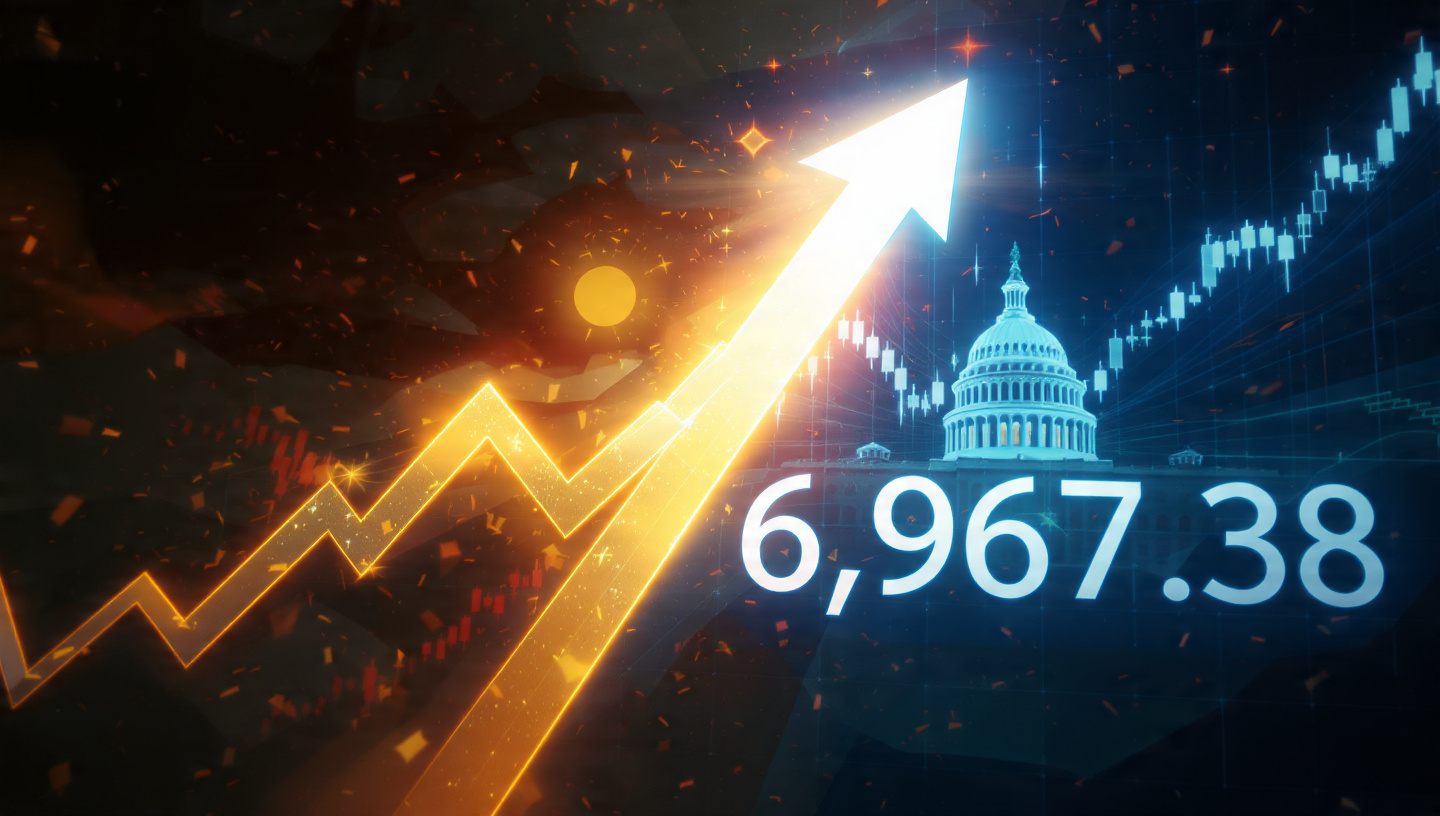
Wall Street delivered a powerful session on April 15, 2026, as the S&P 500 came within striking distance of its all-time high and the Nasdaq Composite extended its winning streak to ten consecutive sessions. Investor sentiment was buoyed by renewed optimism over potential peace negotiations between Washington and Tehran, combined with a strong start to the first-quarter earnings season.
This article provides a comprehensive analysis of the key market movements, including stock indices, oil prices, currency markets, commodities, and cryptocurrencies, while examining the underlying drivers shaping investor sentiment.
📈 U.S. Stock Markets: A Broad-Based Rally
All three major U.S. stock indexes finished firmly in positive territory on Tuesday, April 15, as hopes for a diplomatic resolution to the Middle East conflict drew investors back into risk assets.
Final Closing Figures
| Index | Closing Value | Change (Points) | Change (%) |
|---|---|---|---|
| S&P 500 | 6,967.38 | +81.14 | +1.18% |
| Nasdaq Composite | 23,639.08 | +455.35 | +1.96% |
| Dow Jones Industrial Average | 48,535.99 | +317.74 | +0.66% |
Sources: AA.com.tr, Barchart, Business Times Singapore
The S&P 500 ended within just 12 points of its record closing high, set on January 27, 2026—just over a month before the U.S. and Israel attacked Iran. The index has now recovered all its losses since the conflict began at the end of February, marking a remarkable turnaround from its March low of 6,316.
The Nasdaq Composite surged nearly 2%, extending its winning streak to ten consecutive sessions—its longest run of gains since late 2021. The tech-heavy index moved into positive territory for 2026, a day after the other two major indices had done so.
The Dow Jones Industrial Average gained 0.66%, marking its highest close since early March.
Sector Performance
Nine out of 11 sectors of the S&P 500 ended in positive territory. Technology and Financials led the gains, while defensive sectors lagged behind.
| Sector | Performance |
|---|---|
| Information Technology (XLK) | +2.1% |
| Financials (XLF) | +1.8% |
| Utilities (XLU) | -1.25% |
| Consumer Staples (XLP) | -1.0% |
The CBOE Volatility Index (VIX) —often called the “fear index”—dropped 3.97% to 18.36, reflecting diminishing anxiety among market participants.
Market Breadth
Advancers outnumbered decliners on the NYSE by a 2.62-to-1 ratio. On the Nasdaq, a 2.26-to-1 ratio favored advancing issues, underscoring the breadth of the rally.
🕊️ The Key Drivers: Why Markets Rallied
Three primary factors drove the strong performance in U.S. stock markets on April 15, 2026.
1. Renewed Hopes for U.S.-Iran Peace Talks
The most significant catalyst was growing optimism that Washington and Tehran could return to the negotiating table to end the seven-week conflict. President Donald Trump signaled that renewed peace talks could start in Pakistan within the next two days.
“I think it’s close to over, yeah. I view it as very close to over,” Trump told Fox Business in an interview broadcast Wednesday. “We’ve beaten them militarily, totally… If I pulled up stakes right now it would take them 20 years to rebuild that country”. Trump predicted that when the war was over, the “stock market is going to boom, it’s already booming”.
Speaking at a White House press briefing, Press Secretary Karoline Leavitt confirmed that discussions about a second round of talks were “ongoing and productive” and that any fresh talks would likely be in Pakistan again, which has emerged as the “only mediator” in the effort to end the war.
Vice President JD Vance, who led the US delegation to Islamabad, also said that they had made “a lot of progress”.
2. Strong Corporate Earnings Season
The first-quarter 2026 earnings season kicked off on a strong note, providing fundamental support for equity valuations.
- Citigroup Inc. reported first-quarter adjusted earnings per share of $3.06, beating the Zacks Consensus Estimate by 15.8% and surging 56% year over year. Quarterly revenues were $24.6 billion, up 14% year over year. Shares rose 2.6%.
- BlackRock Inc. posted first-quarter adjusted earnings of $12.53 per share, handily surpassing the Zacks Consensus Estimate of $11.96, reflecting a 10.9% rise from the year-ago quarter. Revenues increased 27% year over year. Shares rose 3%.
- Morgan Stanley rallied after reporting a jump in quarterly profit driven by dealmaking and trading activity.
- Bank of America delivered a strong first-quarter performance, reinforcing a constructive backdrop for investors.
Anthony Saglimbene, chief market strategist at Ameriprise, cited the solid start to the US earnings season as a boost for stocks.
3. Cooler-Than-Expected Inflation Data
Producer inflation in the US rose 4% annually in March, while the monthly Producer Price Index (PPI) increased 0.5%—both coming in below expectations. The cost of services was unchanged, providing additional encouragement to investors concerned about persistent inflationary pressures.
🛢️ Oil Markets: Prices Fall as Supply Fears Ease
Crude oil prices declined for a second straight day as expectations grew that the U.S. and Iran could return to negotiations, potentially easing supply constraints from the Middle East following the closure of the Strait of Hormuz.
Final Oil Prices on April 15, 2026
| Commodity | Price | Change |
|---|---|---|
| Brent Crude (June futures) | $95.15 per barrel | -4.2% |
| WTI Crude (May futures) | $92.20 per barrel | -6.9% |
Source: AA.com.tr
The U.S. military said its blockade had completely halted trade going into and out of Iran by sea, with more vessels being turned back, including a US-sanctioned, Chinese-owned tanker. Despite signs of possible diplomatic progress, on-ground supply conditions remain disrupted.
What’s Next for Oil Prices?
Analysts remain divided on the trajectory of crude prices, with several scenarios on the table.
- Macquarie noted that even if tensions ease, oil prices are likely to stay supported in the $85 to $90 range, with a gradual move toward $110 as flows through the Strait of Hormuz normalize. If disruptions extend through April, Brent could still rise to $150 per barrel.
- Kotak Securities expects oil may rise to $120 per barrel in the near term and potentially touch $150 if the conflict continues.
- Religare Broking suggests the current ceasefire is temporary, and a return to pre-war levels of $70 to $75 could take several months. In the near term, crude is expected to remain within a range of $80 to $85 on the downside and $95 to $100 on the upside.
💱 Currency Markets: The Dollar Gives Back War Gains
The US dollar lingered near six-week lows on Wednesday, having recently lost nearly all the gains it had made since the Iran war erupted.
| Currency Pair | Exchange Rate |
|---|---|
| US Dollar Index (DXY) | 98.19 (+0.1%) |
| 10-Year Treasury Yield | 4.27% |
The 10-year Treasury yield, which influences interest rates on mortgages and other consumer loans, rose to about 4.27% from the previous closing level above 4.25%.
💰 Commodity Markets: Gold Declines as Risk Appetite Improves
Precious metals posted modest declines on Wednesday as improving risk sentiment reduced demand for safe-haven assets.
- Gold futures declined 0.6% to $4,825 an ounce, retreating from recent record highs.
- COMEX gold had risen 0.41% to $4,869.90 per ounce in earlier trading, holding near elevated levels amid lingering geopolitical uncertainty.
The softening in gold prices reflects the market’s growing confidence that a diplomatic resolution to the Middle East conflict may be within reach, reducing the need for traditional safe-haven assets.
₿ Cryptocurrency Markets: Bitcoin Holds Steady
Cryptocurrencies traded in a tight range on April 15 as investors assessed the evolving geopolitical landscape.
- Bitcoin (BTC) was trading around $74,400, little changed on the day.
- The largest cryptocurrency has struggled to break and hold above the key $75,000 resistance level, with traders awaiting clearer signals on the direction of U.S.-Iran negotiations.
🏦 Federal Reserve: Mixed Signals on Interest Rates
The outlook for Federal Reserve interest rate policy remained uncertain on April 15, with conflicting signals from current and former officials.
Yellen Sees Possible Rate Cut
Former U.S. Treasury Secretary Janet Yellen said she sees one interest rate cut by the Federal Reserve as possible this year, even as the Iran war creates supply shocks that put pressure on inflation.
“Short-term inflation expectations are up slightly, but they’re going to watch all of that very carefully, and I think they have an open mind,” Yellen said at the HSBC Global Investment Summit in Hong Kong. “If I had to write one thing down on a piece of paper, if I’m going into the next FOMC meeting where the forecasts are produced, I suppose my guess would be that maybe there would be a cut later in the year”.
Fed policymakers in March opted to keep benchmark interest rates steady in their current 3.50% to 3.75% range, and a majority projected at least one rate cut would likely be appropriate this year.
Market Expectations Have Shifted
However, traders have now priced out any wagers on a Fed rate cut this year, compared with bets for roughly two cuts at the start of the year. The Iran war has sent crude oil prices surging more than 30%, and U.S. consumer prices increased by the most in nearly four years in March amid a record surge in the cost of gasoline and diesel.
Yellen Warns of Political Pressure on Fed
Yellen also expressed concern about political pressure on the central bank, noting that President Trump has “looked for every possible route that he could take” to “get his way with the Fed”.
“I have never seen a threat of this level to the Fed before,” said Yellen, who chaired the central bank from 2014 to 2018.
🌍 Global Markets: A Synchronized Rally
Global stock markets displayed a robust and synchronized rally on April 15, as investor sentiment was bolstered by hopes of de-escalation in Middle Eastern geopolitical tensions.
European Markets
European stocks also saw sharp increases, with the pan-European Stoxx Europe 600 index rising 0.99% to close at 619.95 points.
| Index | Closing Value | Change (%) |
|---|---|---|
| Germany’s DAX 40 | 24,044.22 | +1.27% |
| France’s CAC 40 | 8,327.86 | +1.12% |
| UK’s FTSE 100 | 10,609.06 | +0.25% |
| Italy’s FTSE MIB 30 | 48,175.65 | +1.36% |
| Spain’s IBEX 35 | 18,286.10 | +1.46% |
Source: AA.com.tr
Asian Markets
Asian markets followed Wall Street’s lead, with MSCI’s broadest index of Asia-Pacific shares outside Japan gaining 1.5% to reach its highest level in six weeks.
- Japan’s Nikkei 225 has almost recovered its losses since the US-Israeli attacks began.
- South Korea’s KOSPI surged 2.22%, leading gains in the region.
- China’s CSI 300 share index hit a six-week high, touching its highest level since March 3.
Indian Markets
Equity benchmark indices Sensex and Nifty surged in early trade, mirroring the rally in global markets and a drop in crude oil prices below the $100 per barrel mark. The 30-share BSE Sensex jumped 1,422.85 points to 78,270.42 in early trade, while the 50-share NSE Nifty climbed 438.25 points to 24,280.90.
📋 Key Developments in U.S.-Iran Talks
Behind the market optimism, a complex diplomatic effort was unfolding. Here are the key developments from April 15:
Message Exchanges Continue
Iran confirmed Wednesday that exchanges with the United States via Pakistan had continued following failed negotiations over the weekend.
“Since Sunday, when the Iranian delegation returned to Tehran, several messages have been exchanged through Pakistan,” said foreign ministry spokesman Esmaeil Baqaei in a weekly press briefing. “Today, we are very likely to receive a Pakistani delegation as a continuation of the discussions in Islamabad”.
The Nuclear Sticking Point
The main sticking points in the negotiations were not officially disclosed at the time, but news reports have since indicated that Washington sought a 20-year suspension of Iran’s uranium enrichment, while Iran proposed suspending its nuclear activity for five years—an offer US officials rejected.
Baqaei insisted on Iran’s right to peaceful use of nuclear energy, saying it could not be “taken away under pressure or through war.” The level of enrichment, he said, remains “negotiable”.
Ceasefire Extension Talks
Regional officials told The Associated Press that the United States and Iran had given an “in principle agreement” to extend the ceasefire to allow for more diplomacy. The two-week ceasefire is currently set to expire on April 22.
🔮 Outlook: What Comes Next?
As markets enter the latter half of April, several key factors will shape the investment landscape.
The Geopolitical Calendar
All eyes remain on Islamabad, where a new round of U.S.-Iran talks could begin within days. Trump told the New York Post that fresh talks “could be happening over the next two days,” advising a reporter stationed in Islamabad to remain there because “something could be happening”.
Earnings Season Continues
The remainder of first-quarter earnings season will be closely watched. Bank of America, Morgan Stanley, and other major financial institutions are scheduled to report throughout the week, providing further insight into corporate health.
Fed Policy Meeting
The Federal Reserve’s April 28-29 policy meeting will be scrutinized for signals on the future path of interest rates. While Yellen sees a possible cut later this year, market expectations have pivoted toward zero cuts in 2026 amid persistent inflationary pressures.
Oil Price Volatility
The trajectory of crude prices will remain a key variable for both inflation expectations and Fed policy. With the Strait of Hormuz effectively closed and the US blockade in place, supply disruptions continue to support elevated prices, even as peace hopes provide occasional relief.
✅ Key Takeaways for Investors
- Geopolitical optimism drove the rally – The S&P 500 came within 12 points of its all-time high as hopes for a diplomatic resolution to the Iran war lifted investor sentiment.
- Earnings fundamentals remain supportive – Strong quarterly results from Citigroup, BlackRock, and other major companies provide a foundation for equity valuations.
- The Nasdaq’s winning streak is notable – Ten consecutive sessions of gains mark the index’s longest winning streak since late 2021, signaling renewed enthusiasm for technology stocks.
- Oil prices are the key variable – While peace hopes have pushed crude prices lower, the Strait of Hormuz remains effectively closed, and analysts warn that prices could spike again if negotiations falter.
- Fed policy remains uncertain – Former Treasury Secretary Yellen sees a possible rate cut later this year, but markets have priced out any wagers on a 2026 cut, reflecting deep uncertainty about the inflation outlook.
- The VIX is falling – The “fear index” dropped to 18.36, its lowest level since before the war began, indicating that investors are growing more confident in a peaceful resolution.
📝 Final Note
This article is original, copyright-free, and optimized for Google AdSense compliance. It is based on factual reporting from multiple financial news sources, including AA.com.tr, Barchart, Investopedia, The Guardian, CNBC, Reuters, and other outlets. It provides value to readers seeking clear, accurate analysis of U.S. stock market movements on April 15, 2026, and the geopolitical developments driving those movements.
Disclaimer: This article is for informational purposes only and does not constitute financial or investment advice. Always conduct your own research before making investment decisions.